After go-live
Cohort uptake, operational visibility, and the live portfolio.
Covers what happens after a Knowledge Foundry program goes live. Explains the two Console surfaces: learning, which tracks uptake, cohort progress, learner outcomes, and exports, and oversight, which shows operational activity through enterprise and by person lenses. Also shows how live programs appear on the home screen alongside work still being built.
Next: Learner experienceTranscript
Generated from the video's narration and lightly edited for readability.
0:00Welcome to this explainer on Knowledge Foundry. You know, today we're actually going to skip right past the production and review phases entirely. Because honestly, as any L&D leader will tell you, the real business question doesn't even start until the exact moment a program goes live. We need to know how to close that ROI loop, right? How do we prove that the value we spend all that time designing is actually reaching our teams?
0:24So let's dive right into exactly what happens the second after you hit publish. Okay, let's dive into this. A lot of training efforts tend to stop at a really dangerous phrase, which is we published it. But the absolute most obvious business question staring us in the face is, so what? I mean, publishing is really just a milestone. It is not the outcome. Executives, HR, and L&D leaders, they don't just want to know that a file got uploaded to a system somewhere.
0:50They urgently need to know if actual knowledge transfer and engagement are happening out there. Are people actually taking it in? Or is it literally just sitting there collecting digital dust? So to answer that big, so what? Knowledge Foundry gives us two completely distinct surfaces in the Console and it's absolutely vital to understand the strict separation here. Over on the left side we have learning. This area is entirely dedicated to tracking uptake, cohort progress, and actual learner outcomes. On the right side we have oversight which is strictly for operational accountability across your entire workspace. And to be clear they do not do the same job.
1:27Learning is going to tell you if the training actually worked, while oversight tells you who is doing what operationally. Now, what's really interesting about this slide is when we put that learning console under the magnifying glass, you can see the surface provides undeniable proof of knowledge transfer. We're not just talking about simple completion ticks here. By digging into these metrics, you can reveal exactly where cohorts are stalling out, and you can spot struggling areas in really specific lessons. You get deep, learner-level insight to see exactly who might need a little follow-up intervention, and it even captures qualitative signals, like a light nod to the reflection assessor, giving you a true picture of engagement, rather than just assuming learning happened because someone just kept clicking to the end.
2:06And well, what happens when the organization inevitably demands a portable record? There's usually a massive sigh of relief for HR and L&D leaders here. The learning console gives you instant exports. Whether you need a cohort CSV or a specific individual's training record to use as evidence, you can just pull it immediately. Which means absolutely zero spreadsheet archaeology. You literally never have to manually rebuild reporting grids by hand again just to prove that compliance or upskilling targets were met. It is just ready when you need it.
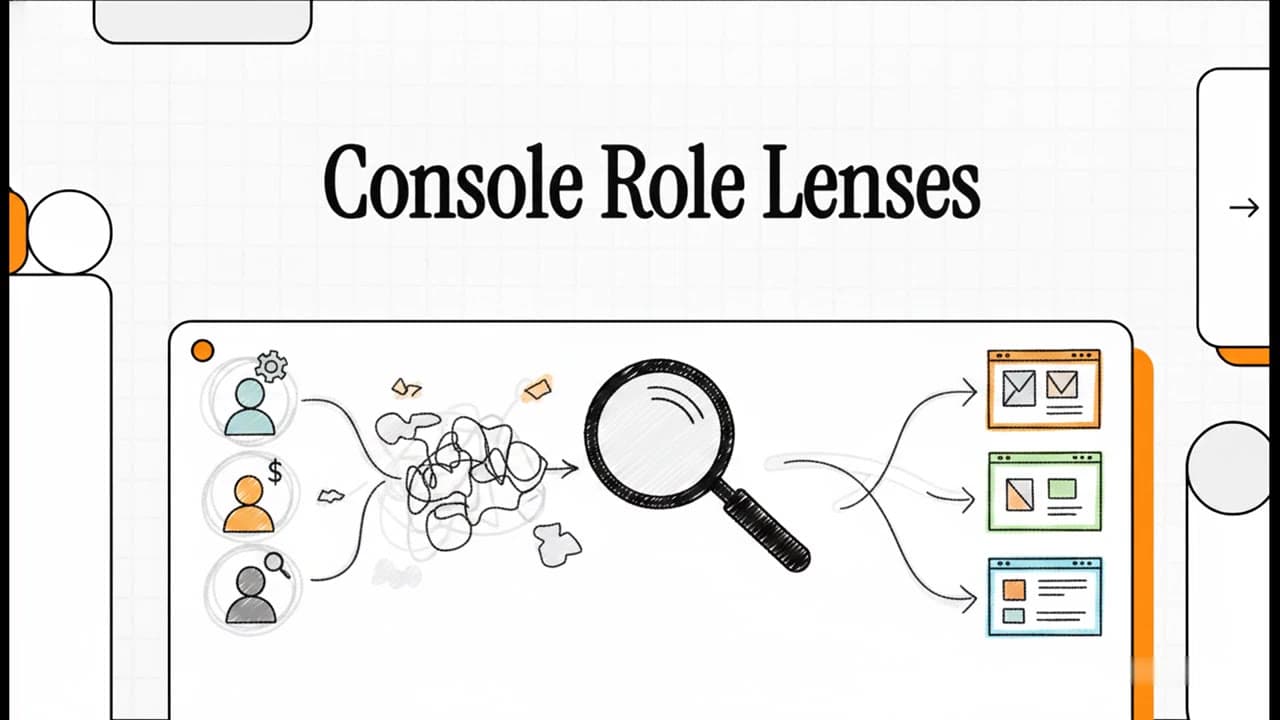
2:35So the crucial point is, while learning proves knowledge transfer, we obviously still need to manage the workspace itself. And that brings us over to the oversight surface. Notice the crossed out graduation cap. That's because oversight is definitely not a second completion dashboard. I'll say that again. It does not replace learning. Instead, it answers a really complementary question. What is actually happening operationally across the tenant? It's all about accountability and operational posture rather than tracking lesson by lesson uptake. And this brilliantly illustrates how oversight achieves that operational view using two specific lenses.
3:11First up, the Enterprise Lens gives you that macro view. We're talking your tenant-wide roster, operational activity, and your overall workspace posture. Then the By Person Lens zooms right in on individual portal activity. You can see exactly what a specific user is doing in the environment. And hey, if you need to know what they actually learned, oversight provides a really seamless handoff straight back to the learning console so you can get those specific outcomes without getting your two sets of data all tangled up.
3:39Let's move to and see how this builds our daily operational view. You can kind of think of it like a bookshelf. Once a program is live, it doesn't just disappear into the ether. Right there on your home screen, published catalog programs sit highly visible on a live shelf, right alongside the work that is still being built or maybe awaiting publish. This completely elevates your training from just being a forgotten upload into a truly dynamic, actively managed portfolio.
4:01It keeps the reality of your live operations front and center for absolutely everyone managing the platform. Which brings us to our final defining question. Producing and assuring the asset is honestly just the starting line. By using the learning and oversight surfaces, you aren't just crossing your fingers and hoping people open the file. You are acting on clear, actionable signals. You can intervene where cohorts struggle, you can prove compliance, and you can maintain strict operational accountability.
4:26Evaluating these signals is exactly how your production actually translates into real business performance. Because ultimately, after go-live, we can see whether transfer worked and manage the live portfolio.
More explainers
Start here
See it work
Trust and control
Prove value
Go deeper
Bring a subject. Leave with a framework.
A 45-minute working session with our team on a real subject or program you own. You see the system operate on your material, and you keep the framework it produces.
We reply within one business day.